Draughts Archive
Rules & Strategy
The strategic board game Nigerians grew up playing. Draughts is retired from new matches, but its Nigerian rules and strategy guide remain available, and completed games can still be viewed in player history and replay.
What is Nigerian Draughts?
Nigerian Draughts is a two-player strategy board game played on a 10×10 board with 20 "seeds" (pieces) per player. It follows International Draughts rules with specific Nigerian adaptations that make the game uniquely tactical — including the freedom to choose any capture path and the dramatic Huff penalty.
Players move diagonally on the dark squares, capture opponents by jumping over them, and promote seeds to "Kings" (flying kings) that dominate the board. There is no dice, no luck — every outcome is decided by pure strategic thinking.
Naija Game Arena no longer accepts new Draughts matches. This archive preserves the rules guide, while player history and completed-game replays remain available through signed-in accounts.
4 Core Concepts
Understand these and you understand Draughts. Every rule flows from these four ideas.
Seeds (Man)
Your starting pieces. Seeds move one square diagonally forward. They capture by jumping over an opponent's seed to the empty square beyond.
Kings (Crown)
When a seed reaches the opponent's back row, it becomes a King — a flying piece that moves any number of squares diagonally, forward or backward.
Mandatory Capture
If you can capture, you must. No exceptions. When multiple captures are available, you're free to choose any path — maximum capture is not required under Nigerian rules.
The Huff
If a King can capture but doesn't, your opponent can "huff" it — seize it off the board entirely. In Expert mode, any piece that skips a capture can be huffed.
How to Play Draughts
Simple rules, infinite depth. Here's everything you need to start playing.
Set Up the Board
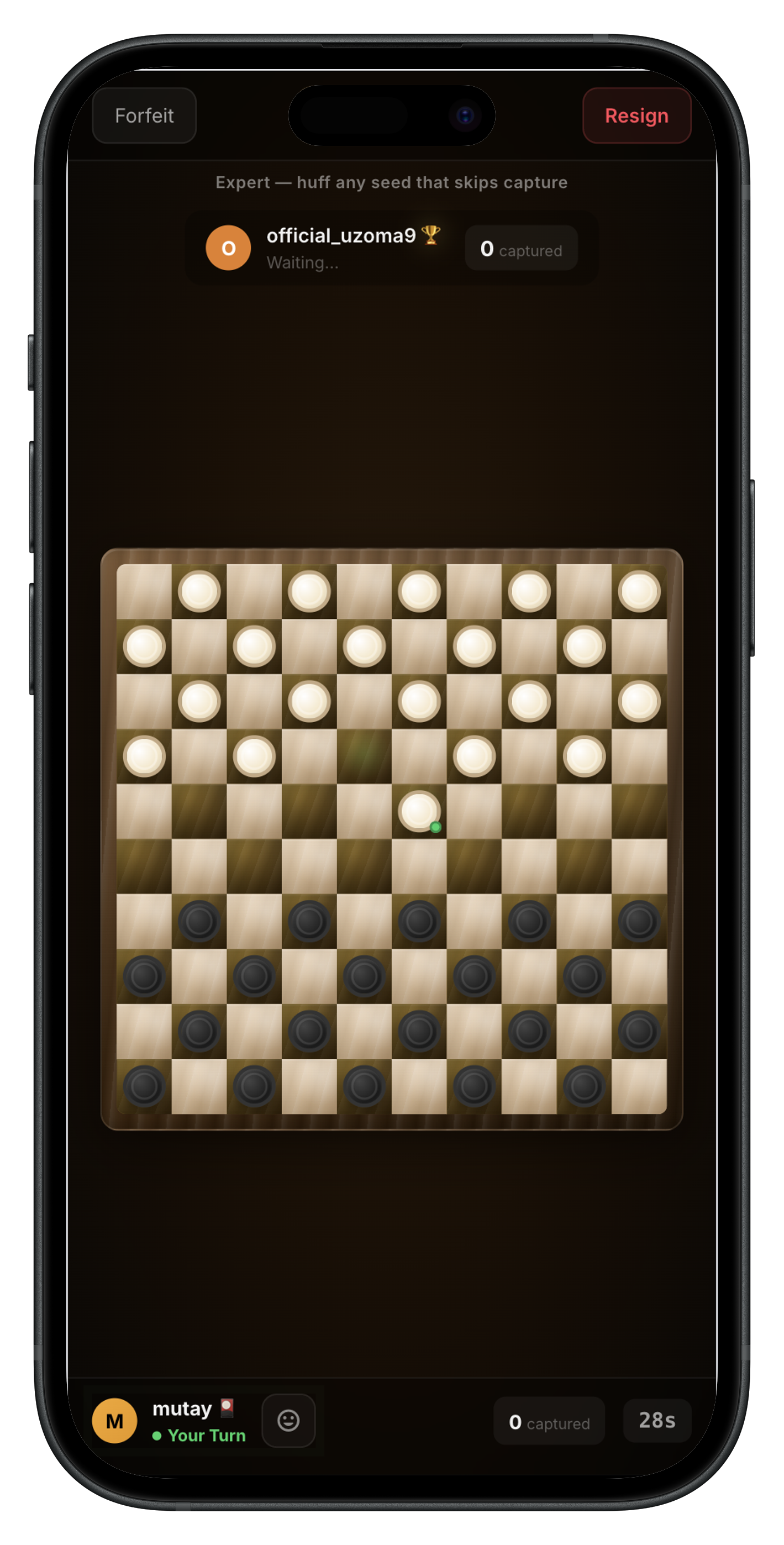
Each player places 20 seeds on the dark squares of their first 4 rows. The two middle rows stay empty. Dark pieces move first. Only the 50 dark squares are in play — seeds never touch light squares.
Move Diagonally
Seeds move one square diagonally forward onto an empty dark square. Seeds can only move forward — never backward. Choose your moves carefully because every square matters on this 10×10 battlefield.
Capture by Jumping
Jump diagonally over an adjacent opponent's seed to land on the empty square beyond it. The captured seed is removed. If you can capture, you must — captures are mandatory under Nigerian rules.
Chain Your Captures
After a capture, if your seed can jump again from its new position, it must continue — chaining multiple captures in a single turn. Multi-jump chains are the most powerful plays in Draughts.
Crown Your Kings
When a seed reaches the opponent's back row, it becomes a King — a flying piece that moves any number of squares diagonally in any direction. Kings capture by flying over opponents and landing beyond them.
Win the Position
Capture every opposing seed or leave the opponent with no legal move. Completed historical games can still be studied through replay.
Nigerian Rules — What Makes Ours Different
We follow the official Nigerian Draughts adaptation, not standard FMJD International rules.
When multiple capture paths exist, you choose any path. Maximum capture is NOT required — unlike FMJD rules.
A King that skips a mandatory capture can be seized (huffed) by your opponent. In Expert mode, this applies to all pieces.
A seed passing through the promotion line during a multi-jump does NOT become a King. It must end its move on the back row to promote.
6 Strategies to Win More
No luck to hide behind. These strategies separate winners from everyone else.
Control the Centre
Seeds in the centre have more diagonal options and are harder to trap. Seeds on the edge can only move one direction — they're half as useful. Fight for the middle early.
Push for Kings
A King is worth more than 3 seeds. It flies across diagonals and captures in all directions. Sacrifice a seed or two to promote faster — the King will earn it back.
Force Captures
Since captures are mandatory, you can force your opponent into bad moves. Offer a seed as bait, then use their forced capture to set up a multi-jump chain of your own.
Protect Your Back Row
Don't move your back-row seeds too early. They form a wall that prevents your opponent from promoting. Once your back row is empty, Kings will flood in.
Trade When Ahead
If you have more seeds, trade pieces at every opportunity. Equal trades favour the player with more material. A 5 vs. 3 advantage becomes 3 vs. 1 — overwhelming.
Set Multi-Jump Traps
The most devastating plays in Draughts are multi-jump captures — one move that takes 3 or 4 seeds. Position your seeds to create these chain opportunities.
Two Game Modes
Only Kings can be huffed for skipping captures. Perfect for casual players and those learning. The standard way Draughts is played across Nigeria.
Any piece — seed or King — can be huffed for skipping a mandatory capture. Higher stakes mentally. One moment of carelessness can cost you a piece.
Draughts Questions Answered
Draughts (also called International Draughts) is played on a 10×10 board with 20 pieces per player — larger than the 8×8 English Checkers board with 12 pieces. The bigger board creates deeper strategy. Kings in Draughts are "flying kings" that move any number of squares diagonally, unlike Checkers where kings only move one square. We follow Nigerian rules, which means you're free to choose any capture path — maximum capture is not required.
No. Draughts has been retired from new matches on Naija Game Arena. Existing completed games remain available in player history and replay.
A typical Draughts game lasts 10–20 minutes. Each player has 30 seconds per turn. Games between experienced players can be shorter (fast captures) or longer (strategic positioning). If 25 moves pass without a capture or promotion, the game is declared a draw to prevent stalling.
Nigerian Draughts follows International (10×10) rules with key adaptations: (1) No maximum capture rule — you're free to choose any capture path, not just the one that takes the most seeds. (2) The Huff rule — if a King skips a mandatory capture, your opponent can seize it off the board. (3) The Over-Crown rule — a seed passing through the promotion line during a multi-jump is NOT promoted; it must end on the back row to become a King.
Pure skill. There is no randomness in Draughts — no dice, no card draws, no chance. Every move is a strategic decision. This makes it ideal for competitive play with real stakes, because the better player wins consistently over time. World-class Draughts has a competitive scene comparable to chess.
Draws can occur by mutual agreement, when neither player can win, or after 25 moves with no capture or promotion.
The Huff is a penalty for skipping a mandatory capture. In Classic mode, if a King can capture but doesn't, your opponent can "huff" (seize and remove) that King on their next turn. In Expert mode, any piece — seed or King — can be huffed for skipping a capture. Your opponent can choose to huff or play a normal move.
Looking for an Available Game?
Draughts is no longer accepting new matches. Explore the current catalogue to choose a game that is available to play.
sports_esports Explore Available GamesMore Games on Naija Arena
Love Draughts? Try our other skill-based games.